

Website Rebuild vs Redesign: What Actually Improves Performance
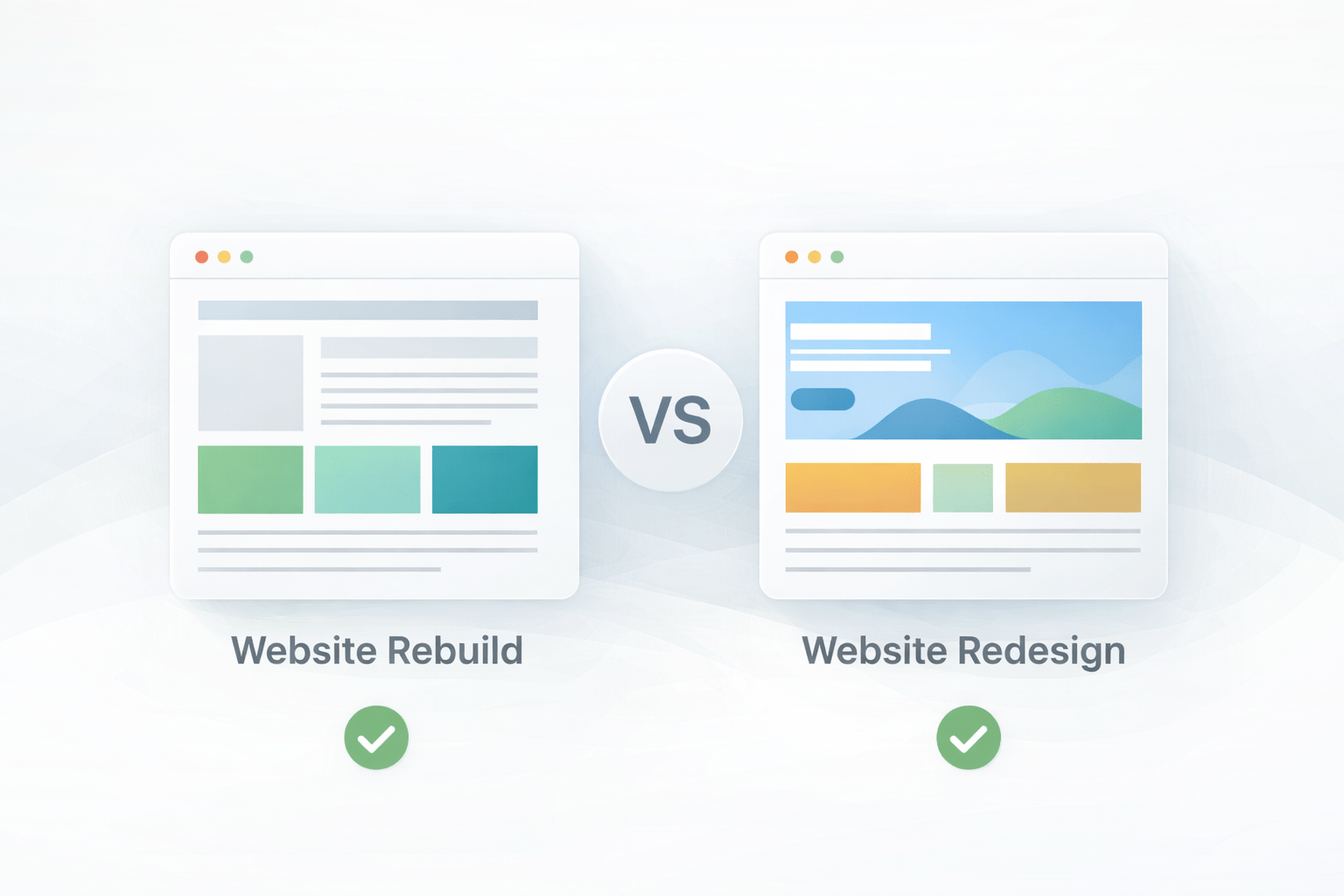
If you’re stuck deciding between a website rebuild vs redesign, the simplest way to choose is this: do you need a better-looking website — or a website that performs better?
Most businesses assume a redesign is the answer because the site “feels dated.” But performance problems rarely come from aesthetics. They come from structure: slow load times, unclear service architecture, thin internal linking, technical SEO debt, and weak conversion flow.
What a Website Redesign Actually Changes
A redesign is typically a visual and layout update. It might improve perception, but it often leaves the underlying problems untouched. A redesign commonly includes:
- New colors, typography, and spacing
- Updated layouts and section patterns
- New imagery and branding polish
- Fresh animation or “modern” visual trends
The issue is that many redesigns get launched on top of the same technical foundation: the same plugin stack, the same bloated assets, the same broken information architecture, and the same unclear page hierarchy.
What a Website Rebuild Actually Involves
A rebuild is a structural correction. The goal isn’t just “new.” The goal is clarity, speed, crawl efficiency, and a user journey that turns visits into calls.
A proper rebuild typically includes:
- Performance audit (speed, Core Web Vitals, asset weight)
- Technical SEO cleanup (indexing, metadata, canonical logic)
- Service architecture (clear service hub + supporting pages)
- Internal linking strategy (topic clusters + clean navigation depth)
- Schema implementation (Organization, LocalBusiness, FAQs where appropriate)
- Conversion structure (primary CTA, trust signals, next-step clarity)
Why Rebuilds Drive Better SEO and Performance
Search engines reward clarity. Users reward speed and direction. A rebuild improves both because it reduces friction at the structural level. Here’s where performance usually improves the most:
1) Crawl clarity and information hierarchy
When services are clearly structured (Services hub → individual service pages → supporting insights), it becomes easier for search engines and AI systems to understand what you do. This strengthens semantic relevance and improves internal authority flow.
2) Page speed and Core Web Vitals
Many WordPress sites are “fine” visually but are carrying unnecessary weight: oversized images, redundant scripts, and plugin bloat. A rebuild reduces payload, improves LCP/INP/CLS, and makes the site feel instant — which directly affects user behavior.
3) Internal linking logic
A strong internal linking structure turns your site into a system. Visitors (and crawlers) can move naturally from discovery → service understanding → action. If you want your site to generate leads consistently, internal links cannot be accidental.
Website Rebuild vs Redesign: Conversion Architecture Matters
A redesign can make the site prettier, but it doesn’t guarantee better conversion. A rebuild forces the hard questions:
- What is the primary CTA — and is it visible within 5 seconds?
- Does every page guide a clear “next step”?
- Do you show proof, process, and trust early enough?
- Is the contact flow frictionless on mobile?
If your traffic is decent but leads are inconsistent, the problem is rarely “branding.” It’s usually conversion architecture.
When a Redesign Is Actually Enough
There are times when a redesign makes sense — specifically when your structure is already strong and performance is already solid. A redesign may be enough if:
- Your site is fast (and stays fast on mobile)
- Your services are clearly structured and easy to understand
- Your internal linking is intentional
- Your technical SEO has been maintained (not “set and forget”)
- Your conversions are healthy, but the site looks dated
How to Choose: The Quick Decision Test
If you’re deciding between a website rebuild vs redesign, use this:
- Redesign if your site performs well and only perception is lagging.
- Rebuild if your site underperforms in speed, SEO, structure, or conversion.
Final Thought
A rebuild is not “more expensive design.” It’s architectural correction. When done properly, it compounds: faster site → better engagement → clearer relevance → stronger rankings → more qualified leads.
If you want a website that performs like a system — not a brochure — a rebuild is usually the right move.